



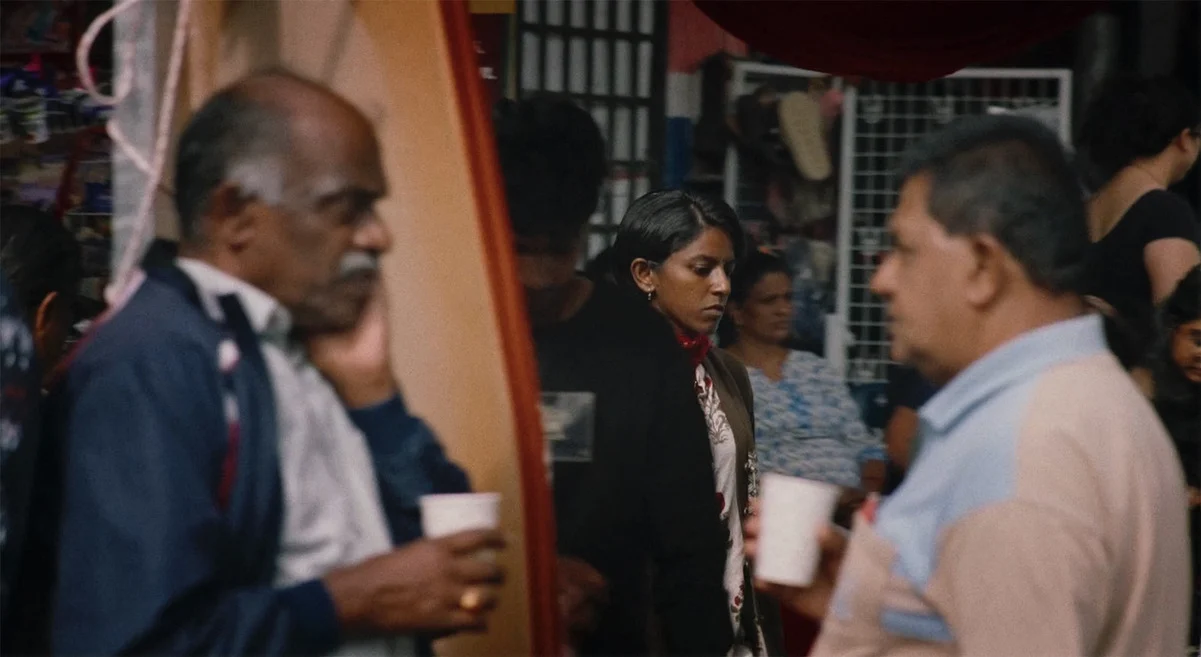
For years, Sarah Lingam has been the person you don’t see. As a director and assistant director, she has worked behind the camera, keeping schedules on track, watching the shots and thinking about the edit. So when she stepped in front of it for the first time in Krityishaa Karunagaran’s short film Flame of the Forest, she did not expect to walk away with an award at the Singapore International Film Festival for her debut performance.
The recognition has left her a little unmoored. “I’m still processing it,” she says. “I still feel a little identity crisis there, not from the outside, but within myself.” Calling herself an actor, she admits, does not yet come naturally. Director and assistant director are the titles she knows.
What she does feel, clearly, is gratitude, and a sense that the honour is not hers alone.
“There are so many people out there who have been doing this for years and are still waiting for the recognition they yearn or truly deserve,” she says. “To receive this on my very first try, I feel nothing but grateful. And I feel this recognition belongs to all of them too. I would like to share this with them.”
An AD’s brain on an actor’s set
Sarah’s years behind the scenes gave her plenty to draw on, but they also followed her onto set. “It was helpful in so many ways,” she says. “But I’ll be honest, having been behind the scenes mostly as an AD for the past few years, shutting down that part of my brain was a little difficult for me.”
Her instincts kept pulling her toward the technicalities of the set: the schedule, the editing, the shots. She had to keep reminding herself to focus on her character and cut out the external distractions. Help came from the assistant director on Flame of the Forest, Lena, who is also Sarah’s friend. “He would notice this and jokingly tell me, ‘Saralah, you are not an AD now. You are Kumudha. Be in character!'”
It worked, more or less. “By the second and third day of the shoot, I was getting better at it,” Sarah says. “At least that’s what I think.”
Asked about the hardest scene, she is careful with her words. No scene was hard, she says, though several were challenging. One stands out: a scene shot during the film’s patch schedule, when she struggled to find Kumudha again. “But my director was patient with me,” she adds.
A set that felt safe
That patience, it turns out, was part of what made the experience special. Flame of the Forest was directed by a woman and is built around a female lead, and Sarah says that shaped the atmosphere on set. “It was comfortable. I felt secure. Not that it wouldn’t be the case if the director was a man, but with Krityishaa, there was a sense of belonging.”
She describes Krityishaa as sensitive and approachable, someone who made room for conversation long before the cameras rolled. The two talked about all kinds of things, some related to the shoot and some not at all. “That broke so many barriers in me,” Sarah says.
There was also a deeper reason she said yes. Krityishaa has built a body of work around women’s stories within the Malaysian Indian community, and Sarah had seen it first-hand. After watching Krityishaa’s short film Tomorrow is Spring, she saw a filmmaker who was “nuanced, sensitive, honest and rebellious.” A woman’s story, she says, was told as it is.

“I felt represented. I felt hopeful. I felt proud, because I saw a fellow female filmmaker from my own community standing there, trying to tell honest stories. That’s what I strive to do as a filmmaker too. She inspires me.”
Being cast by such a director, then, came with weight. “Responsible” is the word Sarah uses. “When it was decided that I was going to be Kumudha, I knew who I was going to be representing and the responsibility that came with it. We don’t see many of our stories being told close to reality.”
Kumudha, and the things that go unquestioned
Flame of the Forest follows a young woman balancing her duty to family with her own sense of self. Sarah is quick to point out that she and Kumudha are very different people in temperament. But the world Kumudha comes from was familiar.
Sarah was born in a small town and raised in a very traditional Tamil household, where boys and girls were treated differently in clear ways. “This always built a sense of dissatisfaction in me, which eventually turned into anger and found its way into different forms of expression,” she says.
The restrictions, she explains, came wrapped in culture and family honour. “The women in my family were expected to behave a certain way or fulfil certain duties in the name of culture or family honour. All of this happened so seamlessly, so normally, that it was rarely questioned.” It was only in their late teens, as exposure to the outside world grew, that Sarah, her siblings and her cousins began to ask why.
That history gave her a way into Kumudha’s emotional life. “Like Kumudha, there have been moments where I’ve had my own outbursts. I’ve also seen some women in my life go through similar experiences. The dynamics, the level of rage or the way they express it may vary, but I think there comes a point in their lives when that tension or suppression has to find a way out.”
“We are not saints”
Sarah has strong views on what is missing from Malaysian Tamil cinema. The flaws, imperfections and inner worlds of women, she says, are rarely explored, and when they are, it is often through a male perspective. “In the Malaysian Tamil cinema landscape, women’s roles often carry a male gaze, shaped by how men perceive women or how they think women should be.” She suggests this may be because there are simply more male filmmakers than female ones.
Her answer to that is blunt, and refreshing.
“We do stink. We can be messy, troublesome, rebellious, destructive. We make mistakes, sometimes repeatedly. We are not saints. There is no need to glorify us. We are messed-up creatures too.”

She points to Bad Girl, directed by Varsha Bharath, as a recent film she enjoyed in this spirit. What she wants to see more of is women “as they are. Flawed, complicated, unapologetic and human.”
What comes next
So is Sarah an actor now? Friends and well-wishers keep asking her whether she will take on more roles or return behind the camera. She jokes that she is an “accidental actor.” Flame of the Forest reached her at the most unexpected time, and at first she could not understand why Krityishaa would want to cast her, given that they had never even met in person. Hearing the story changed that. “I kind of understood why and how this story made its way to me.”
She is also candid that acting was not entirely out of nowhere. “I’m not gonna lie, I’ve always been curious about acting and had an interest in it. It’s one of those things where you know you have it in you, but your self-doubt stops you from exploring it. That’s what acting has been for me. I think I should let go of that self-doubt.”
Still, her priorities are clear. “My priority right now is direction. I want to tell stories. I want to explore that and practise direction, and learn the craft.” The door to acting is not closed, though. “If a story comes my way that really interests me and if I also feel I could fit into the role and do justice to it, then I would give it a try.”
For now, the woman who spent years making sure everyone else was in the right place at the right time has a trophy of her own, and a role she says she will share with every woman still waiting to be seen.