



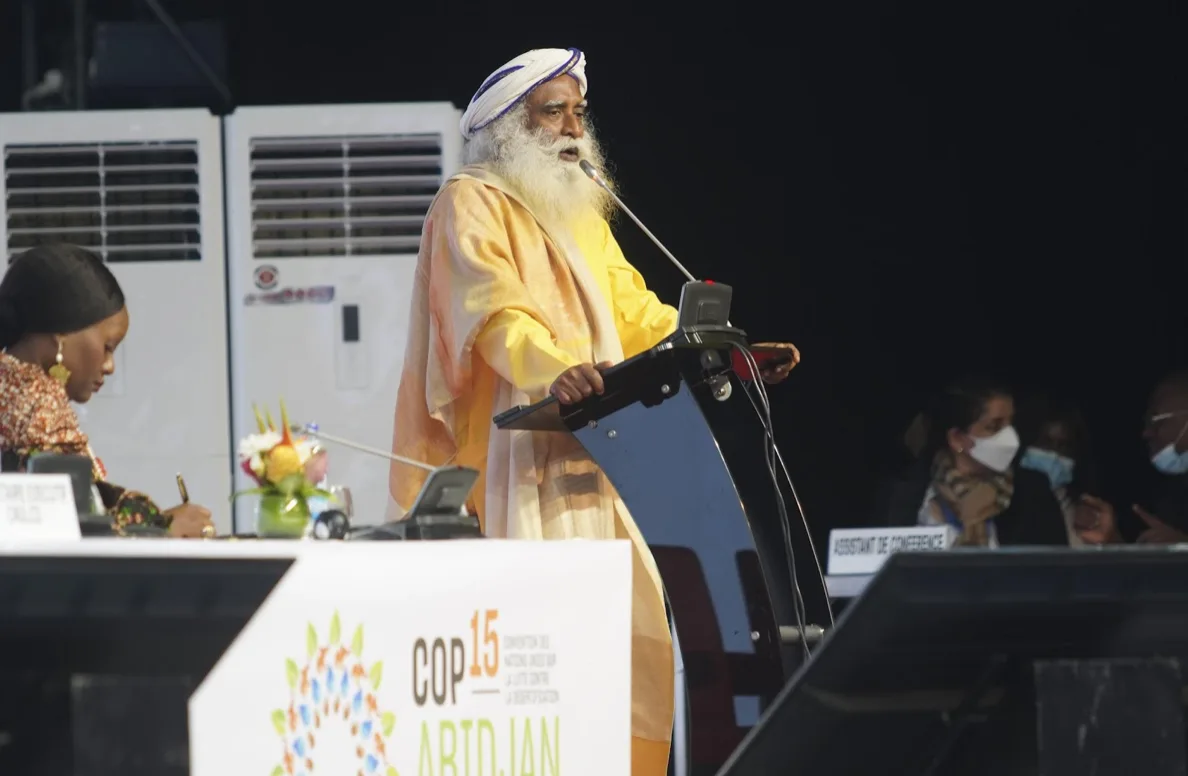
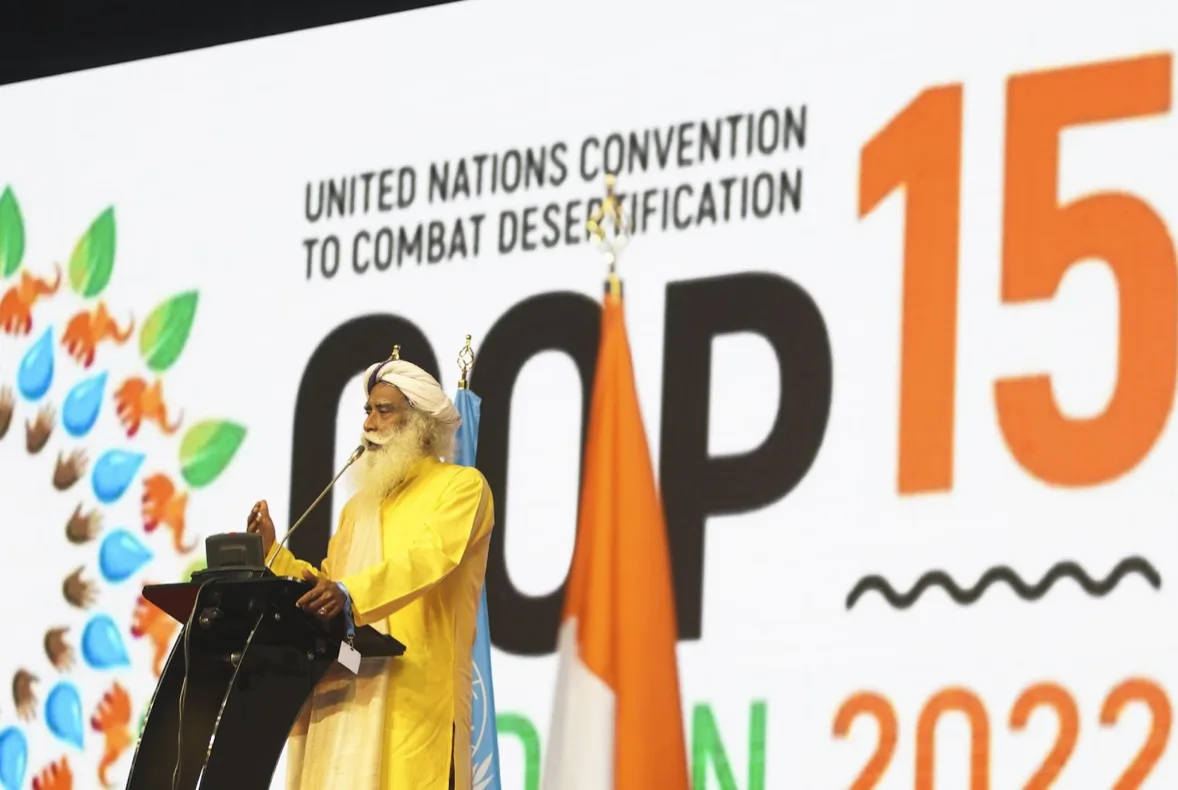
Sadhguru, who is currently on a 100-day, 30,000-km lone motorcycle #JourneyForSoil flew to Abidjan in Ivory Coast to address representatives from 197 nations at the 15th session of the Conference of Parties (COP15) to the United Nations Convention to Combat Desertification (UNCCD). Sadhguru in his address distilled out one overarching objective – which is to ensure that there is a minimum of 3-6% organic content in agricultural soil and provided a three-pronged strategy to achieve this. The solution presented by Sadhguru is quoted below.
Save Soil Movement’s solution to Global Agricultural Land Degradation – Presented at COP15 by Sadhguru
The gathering of all the countries of the world at the COP15 summit in Cote d’Ivoire is a key opportunity to redouble governmental policy efforts aimed at reversing the degradation of agricultural land all around the world, and in so doing bring humanity back from the very brink of Soil extinction.
To Save Soil at large scale we need to shape a deep-rooted People’s movement. Notwithstanding the complex nature of the ecological problem facing us, a successful People’s movement can be created only if we can distill the remedial action into just one single-minded focus that is articulated in a succinct and simple way. Our history of ecological effort shows very few unequivocal successes – largely because we failed to convert complex scientific arguments into easy to understand simple actions. The Montreal protocol of 1987 is often hailed as the single most successful international agreement to date – and that happened because there was a singular focus on doing just one thing – halting the depletion of the ozone layer.
In much the same way, there are many scientific nuances on how to handle the problem of land degradation in different types of soil conditions, in various agro-climatic zones, and in the differing contexts of cultural and economic traditions. It is nevertheless possible to distill out one overarching objective – which is to ensure that there is a minimum of 3-6% organic content in agricultural Soil. This would make our Soil vibrantly living, and sustainably thriving across all agricultural lands.
This overarching objective of ensuring a minimum 3-6% of organic content for agricultural Soil can in turn be achieved with a pragmatic three-pronged strategy:
- We need to make it aspirational for farmers to achieve the minimum threshold of 3-6% organic content by providing attractive incentives for getting to this threshold. Such incentives would create an aspirational race amongst farmers. It should be noted that there should be a phased program of implementation over a number of years – with the first phase being that of providing inspiration, followed by a second phase of providing incentives, and eventually having a third phase with some appropriate disincentives.
- We need to facilitate carbon credit incentives for farmers. The current processes for farmers to avail of carbon credit benefits are far too complex – and therefore need significant simplification.
- We need to develop a mark of superior quality for food grown from Soils that have the target 3-6% organic content level. Alongside doing this, we should also clearly articulate the various health, nutritional, and preventive health benefits of consuming such foods. As a result of this initiative, people would be more healthy, more productive, and more resilient – thereby leading to gains in man-days, and a lower stress on our health care systems. It is therefore evident that such a mark of superior quality food would have far more meaning than the current system of just trying to distinguish between so called ‘organic’ produce from ‘non-organic’ one.
Time is running out. But fortunately we know what to do. With the development of appropriate Government policies, we can turn the clock back on the impending extinction of Soil. To facilitate this task of rapid Government policy evolution across the world, the Save Soil Movement is creating a handbook of recommendations for every one of the 193 countries. More details can be obtained from the movement’s website at Savesoil.org.
Let us make it happen!
Taking to twitter Sadhguru shared, “The most important thing is to recognize soil as a living entity & keep it alive. More than 85% of the nations on the planet still look at soil as an inert substance. This approach must change immediately if we want to #SaveSoil.
The most important thing is to recognize soil as a living entity & keep it alive. More than 85% of the nations on the planet still look at soil as an inert substance. This approach must change immediately if we want to #SaveSoil. -Sg #UNited4Land #UNCCDCOP15 #SaveSoilAtCOP15 pic.twitter.com/1x5CxnUdKg
— Sadhguru (@SadhguruJV) May 11, 2022
Ibrahim Thiaw, Executive Secretary of UNCCD, in his tweet thanked Sadhguru for his commitment to save soil. He shared, “Our problem is that 70% of land is ploughed and 4.2% is paved… The real fixing that we need is on agricultural land. Keep the soil alive: #UNCCDCOP15 needs to end with implementable action.”
“Our problem is that 70% of land is ploughed and 4.2% is paved… The real fixing that we need is on agricultural land. Keep the soil alive: #UNCCDCOP15 needs to end with implementable action.” @SadhguruJV we are grateful of your commitment.#SaveSoil #LandLifeLegacy pic.twitter.com/uqzYGq61lY
— Ibrahim Thiaw (@ibrahimthiaw) May 10, 2022
Sadhguru will return to the Middle-East after the COP15 session to resume his journey which began on 21st March from London. He reached the Middle-East in May riding through Europe and Central Asia where the Movement to Save Soil garnered tremendous goodwill and support from governments and citizens.
-This article is a contribution by Isha Foundation in collaboration with Varnam Malaysia-