



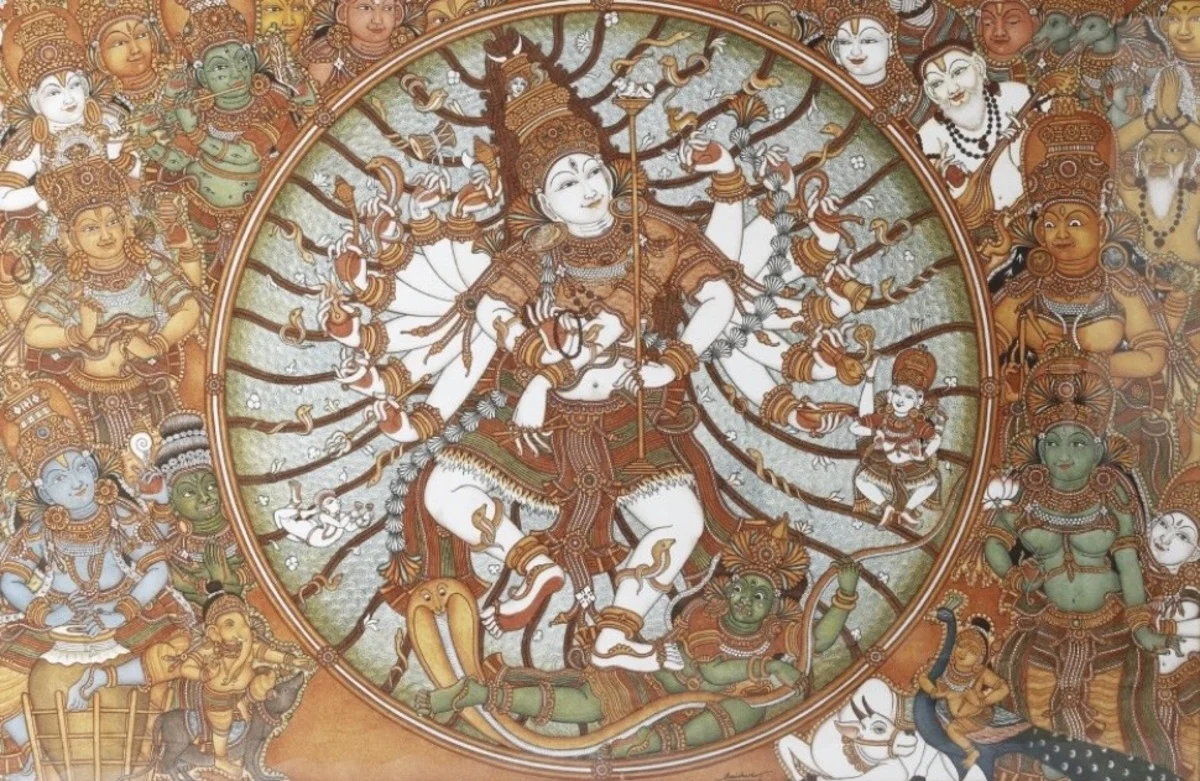
The phrase, Aani Utthiram, consists of the word, Aani, denoting the third month in the Tamil calendar, which lasts from mid-June to mid-July, and the word, Utthiram, which refers to the 12th among the 27 asterisms in Hindu astrology. Unlike most other Hindu festivals that consider the full moon day, Aani Utthiram occurs on the day when the asterism, Utthiram, is in the ascendant in the Tamil month of Aani.
Aani Utthiram is also known as Aani Thirumanjanam in some places.
Thirumanjanam translates into ‘a ceremonial bath. In other words, it refers to the abishegam done for the deities in a temple. Through this fact, it is suggested that Aani Utthiram’s special feature is the special and elaborate ceremonial bath performed for Lord Nadarajah on this day.
Why is the ceremonial bath considered the most essential ritual of this special occasion?
The answer is that Lord Nadarajah is fond of abishegam. As he is very pleased with Abishegam, over time, he also became known as Abishega Piriyar. In a year, six days are designated for Nadaesar Abhishegam.
Why just six days for Nadaesar Abishegam?
Now, to answer this question, we have to recall the knowledge imparted in our Aagamas; that suggest that temples should ideally perform six poojas a day. Although the majority of temples in Tamil Nadu have six poojas a day, in Malaysia, it is quite rare to come across temples doing the same. The timings for the six poojas in the famous Chidambaram Temple are as follows:
- Kaala Sandhi (7.30 am to 9.00 am)
- Second Kaalam in the morning (10.00 am to 11.00 am)
- Ucchi Kaalam (11.30 am to 12.00 pm)
- Saaya Ratchai (5.15 pm to 6.00 pm)
- Second Kaalam in the evening (7.00 pm to 8.00 pm)
- Artthajaamam (9.00 pm to 10.00 pm)
These six times can be respectively referred to as early morning, morning, noon, evening, early night and midnight in English.
One more point to recall is that one day for the celestials is equivalent to one year on Earth. As we perform abishegam for Lord Nadaraajar six times a year, it will be equivalent to the six poojas performed by the celestials in their one day. This seems to be an effort taken to eradicate the effects of any shortcomings that may occur as a result of not performing six poojas a day.
The six days for Nadaesar Abishegam, according to the schedule of the Chidambaram Temple, are:
- On the day of the fourteenth phase of the waxing moon (Valarpirai Sadhurtthasi) in the Tamil month of Maasi (mid-February to mid-March), equivalent to the time between 8.00 am and 10.00 am for the devas; abishegam is done in the evening (Saaya Ratchai).
- On the day when the asterism, ThiruvoaNam, is in the ascendant in the Tamil month of Chitthirai (mid-April to mid-May), equivalent to the time between 12.00 noon and 2.00 pm for the devas, abishegam is done in the evening.
- On the day when the asterism, Utthiram, is in the ascendant in the Tamil month of Aani (mid-June to mid-July), equivalent to the time 4.00 pm to 6.00 pm for the devas, abishegam is done early in the morning (before dawn).
- On the day when the fourteenth phase of the waxing moon in the Tamil month of AavaNi (mid-August to mid-September), equivalent to the time between 8.00 pm and 10.00 pm for the devas, abishegam is done in the evening.
- On the day when the fourteenth phase of the waxing moon in the Tamil month of Purattaasi (mid-September to mid-October), equivalent to the time between 10.00 pm and 12.00 midnight for the devas, abishegam is done in the evening.
- On the day when the asterism is in the ascendant in the Tamil month of Maarghazhi (mid-December to mid-January), equivalent to the time between 4.00 am and 6.00 am for the devas, abishegam is done early in the morning.
Among the six abishegam days, Aani Thirumanjanam and Maarghazhi Thiruvaadhirai are the ones which are celebrated as grand festivals. The reason for this is quite transparent. The celestial timings equivalent to these two months are 4.00 to 6.00 in the morning and evening, respectively. Of the six timings for the Temple poojaa, the more important timings are the ones in the morning and evening. As a matter of fact, if we can do only one poojaa, the evening is the chosen time. Incidentally, the asterism, Thiruvaadhirai, is auspicious to Lord Siva. The abishegam for these two festivals is performed before dawn.
The month of Aani is equivalent to 4.00 pm to 6.00 pm for the celestials; the abishegam for Aani Utthiram would be expected to be performed in the evening. As mentioned earlier, temples must arrange their timings from a practical point of view. As these two days are celebrated as grand festivals, it will be suitable to perform the elaborate abishegam early in the morning, thus allowing the rest of the day for other festive rituals. As for the other four days, Nadaesar Abishegams are scheduled for the evening.
Having known the basic reason for the auspiciousness of Aani Utthiram, it will be of interest to reflect on the logical basis found in the performance of rituals related to special festive days.
Earlier, it was mentioned that Lord Nadarajah is commonly referenced as Abishega Piriyar, while Lord Vishnu is referred to as Alanggaara Piriyar (one who loves adornment) and Lord Siva is always associated with fire. His body is as red as fire.
On the contrary, Lord Vishnu is blue in colour; he is a cool protector of the world; He lies on the bed of a cool snake, which again is found in the sea of milk. As the protector (ruler) of the earth, He is always dressed like a king.
Moreover, Thulasi is auspicious for Him, because Thulasi imparts warmth to the consumer; whereas, the Vilvam leaf is auspicious for Lord Siva as the leaf lends a cooling effect to its consumer.
On this Aani Utthiram, this casual observation is intended to spread ancient knowledge about our Hindu beliefs, culture, rituals and practices that are inevitably interwoven on a philosophical, scientific and logical basis.
Source: Hindu Blogspot