



Bringing Homer’s foundational classic to life on an unprecedented scale, the highly anticipated arrival of Christopher Nolan’s magnum opus hit cinemas worldwide on July 17, 2026. The three-hour masterpiece, which has already become one of the most talked-about releases of the year, stars Matt Damon as King Odysseus, Anne Hathaway as his queen Penelope and Tom Holland as their searching son Telemachus.

While the film majorly anchors elements of Western literature, Indian audiences are bound to experience a sense of cultural familiarity. Travelling across nearly 3,000 years, Homer’s ancient Greek epic may belong to a different civilisation, but its themes of exile, war, supernatural forces and a long journey home strongly resemble the foundational narratives of one of India’s ancient epics, the Ramayana.
The Ramayana is believed to have been written around the 7th to 1st Century BC by the sage Valmiki, and the Odyssey has been crafted by Homer around the 8th or 7th Century BC. These works were written in different corners of the world, featuring different heroes, different settings and different historical traditions. Yet, when placed side by side, one would realise that both these epics discuss the journeys of the heroes, the loss of their beloved wives, the struggles that they go through and also the restoration of justice. They reveal remarkable similarities in storytelling, symbolism and the challenges faced by their central characters.
Homecoming
The most uncanny resemblance lies in the painful and transformative journey of exile. In The Odyssey, Odysseus, the king of Ithaca, spends 10 years fighting in the Trojan War before embarking on another decade-long journey home, in which he battles shipwrecks, monsters, temptations and the wrath of vengeful gods before finally returning home to his wife Penelope and son Telemachus.
This directly mirrors the fourteen-year forest exile of Prince Rama in the Ramayana as his journey along with Sita and Lakshmana. In his journey, Rama passes through forests, crosses the ocean, kills Ravana, and returns to Ayodhya. In both stories, the return of the protagonist heralds the restoration of peace at long last. Just as Odysseus must resist the tempting lotus-eaters and outwit the Cyclops, Rama must navigate demon-infested forests and maintain his moral compass. The circumstances are different, but the emotional idea is familiar: the hero is separated from home and must endure a long, difficult journey before returning.
The virtuous spouses
As the heroes face physical dangers abroad, their wives must endure psychological warfare at home. In The Odyssey, Penelope is trapped in her own palace, besieged by over a hundred aggressive suitors who seek to usurp her husband’s throne.
This scenario closely resembles Sita’s captivity in Ravana’s Ashoka Vatika. Both queens are isolated, physically vulnerable, and pressured by powerful, arrogant forces, yet both employ remarkable intellect to survive.
Penelope delays her suitors for years by promising to choose a husband only after weaving a burial shroud, which she secretly unravels every night. Meanwhile, Sita utterly refuses to look at Ravana, placing a single blade of grass between them as a barrier of absolute moral boundaries. Both women maintain absolute loyalty, using tactical stalling to protect their homes and kingdoms until the rightful king returns.
The hero prevails in the face of supernatural forces
In the Ramayana, Ravana’s plan succeeds as the magical golden deer distracts Rama and Lakshmana, allowing Sita’s abduction. The Odyssey on the other hand, also features supernatural tricks and magical beings that repeatedly deceive Odysseus during his voyage. Witches, enchantresses and mythical creatures constantly test his judgment and determination.
Although the stories are not direct equivalents, the narrative idea is familiar: a hero’s journey is repeatedly interrupted by forces beyond the ordinary human world, some appearing as monsters and some as illusions that test the hero’s judgement.
Divine Guidance
In these epics, the gods are never distant figures. Athena, the Greek goddess of wisdom and warfare, repeatedly helps Odysseus, offering guidance and protection, while Poseidon works against him. In the Ramayana, divine forces, such as Hanuman, lord Shiva and lord Brahma, are central to the larger story of Rama’s life and mission.
The gods may guide, protect or influence the protagonists, but the heroes must still face their choices and consequences. Odysseus still has to find his way home, and Rama must endure exile and loss.
The significance of the great bow
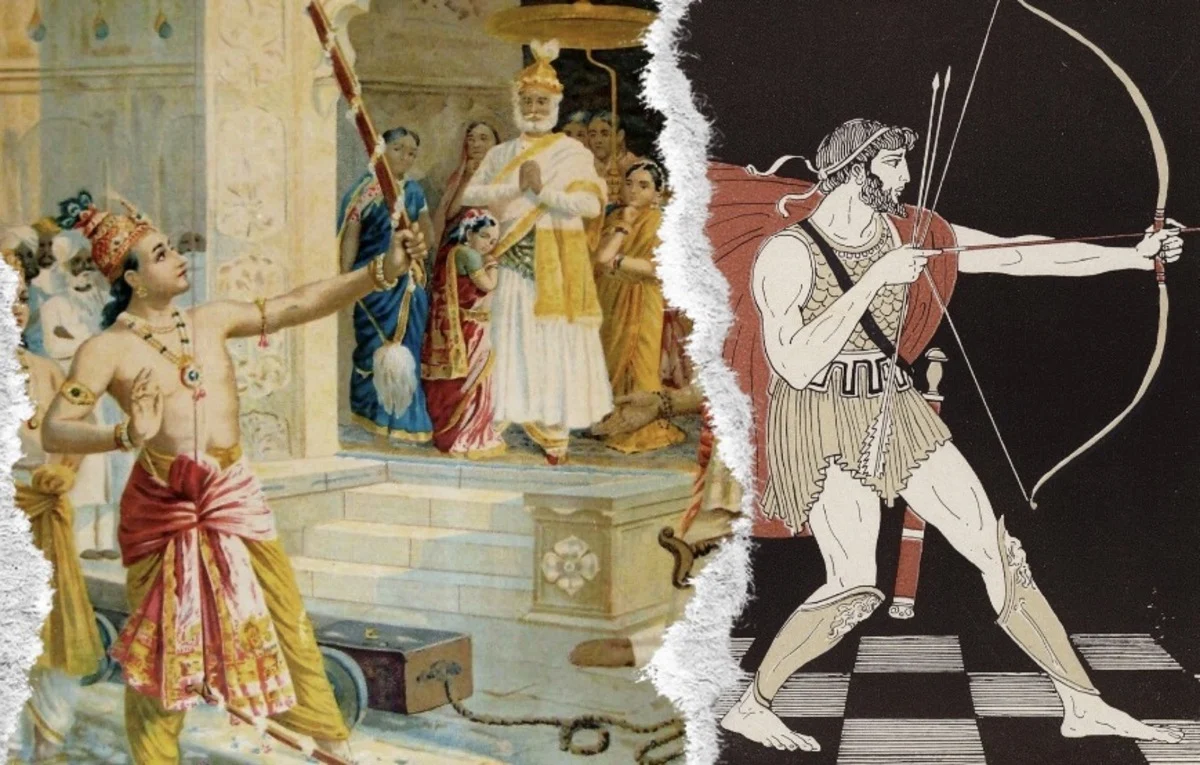
Both epic traditions feature a legendary trial of archery. To reclaim Penelope and his kingdom in The Odyssey, a disguised Odysseus must string his heavy, ancient bow– a feat no other suitor can accomplish- finally revealing his true identity after returning home. In Sita’s case, King Janaka declares that any individual who can wield the celestial bow of Lord Shiva will get married to Sita. Many kings have tried but could not even nudge it. Rama successfully lifts the bow and snaps it while stringing it.
In each story, the bow becomes much more than a weapon, representing far more than physical strength. It serves as a symbol of cosmic justice, the hero’s identity, strength and rightful place.
Ages before cinema, ancient storytellers were already asking similar questions. What happens when a person is separated from home? How does one survive exile? And what does it mean to finally return? That is precisely why The Odyssey feels strangely familiar to Indian audiences. Its gods are Greek, its monsters belong to Greek mythology and its landscapes are set across the Aegean world. But its emotional core – exile, endurance, family, divine intervention and the longing for home remains universal.