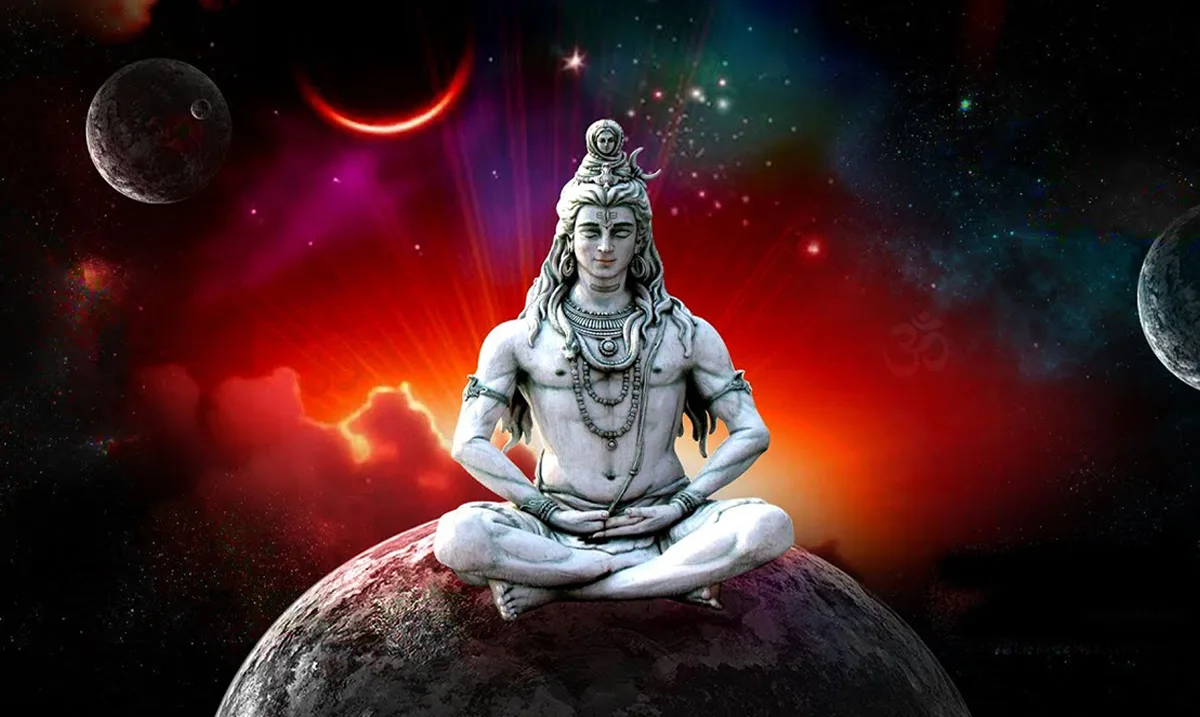
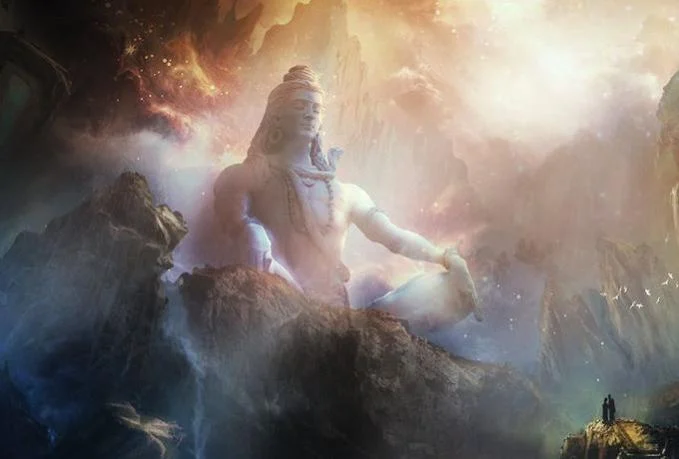
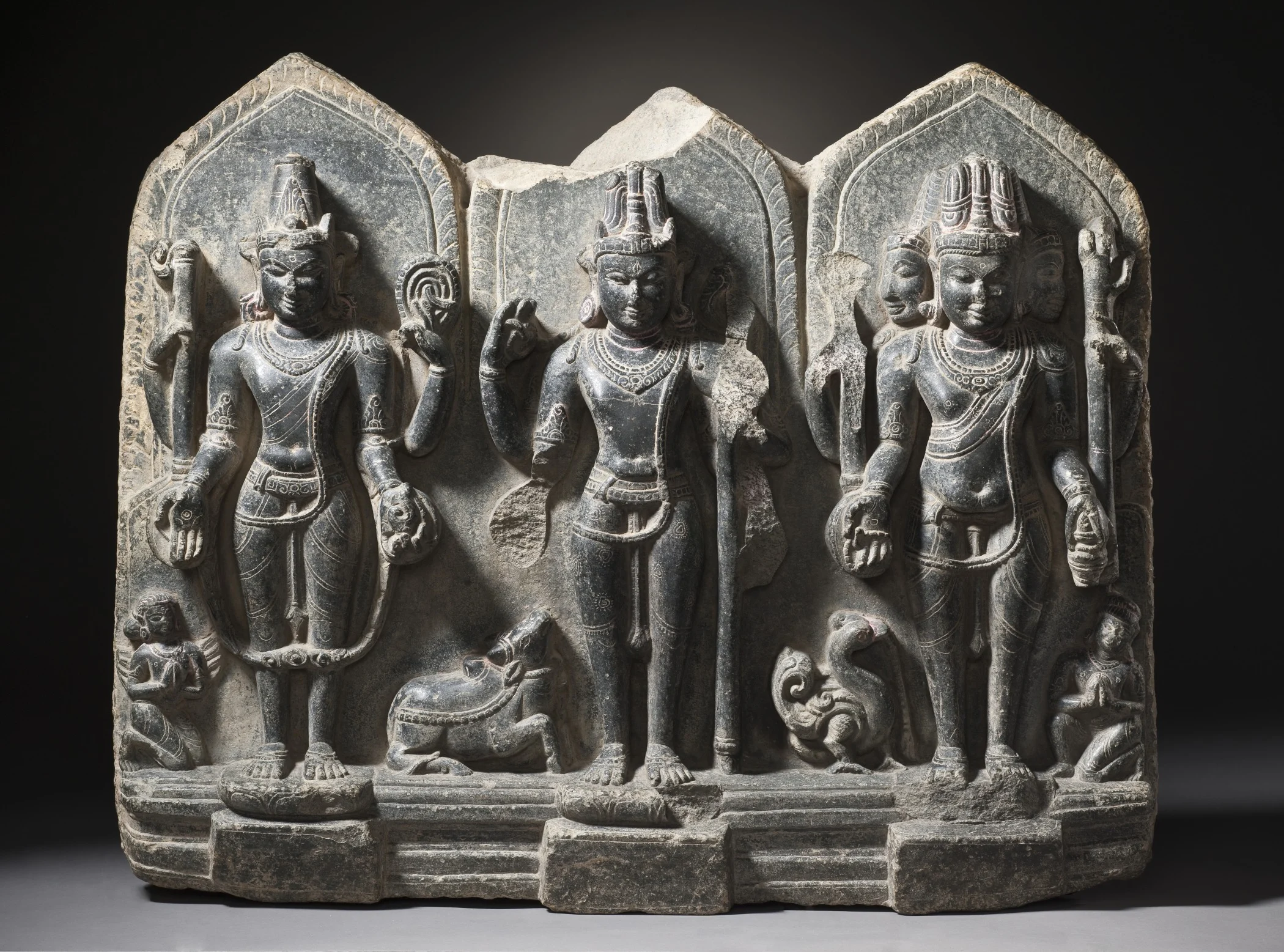
These are some of the many names of Lord Shiva, the third deity in the Hindu triumvirate (trimurthi). The three Gods in the Hindu pantheon are Brahma, The Creator, Vishnu, The Preserver and Shiva, The Destroyer. Shiva guards time, destruction, wellbeing, art and benevolence. He is the ultimate God in Shaivism, the patron of Yogis and the protector of Vedas. The Hindu unit of time denotes that the Universe is regenerated every 2,160,000,000 years upon Lord Shiva’s destruction at the end of the cycle, allowing a new creation to occur.
The 10th century artwork from Bihar showing the trinity of Vishnu, Shiva and Brahma
The Maha Shivaratri is an annual Hindu festival observed in honour of Shiva just before the arrival of summer. The festival that translates as “The Great Night of Shiva” is observed by devotees from around the world in a multitude of practices and acts of devotion. The Maha Shivaratri is mentioned in ancient holy scriptures including the Skanda Purana, Linga Purana and Padma Purana.
Devotees performing a milk bath for Shiva Linga
There are many legends that surrounds the significance of observing the Maha Shivarathri. In Yogic practices, Shiva is not viewed as a Divine God but rather the first teacher, the Adhi Yogi. On the Maha Shivarathri, the northern hemisphere of the planet is positioned in a way that causes a natural upsurge of energy. This is why the Maha Shivarathri is a nightlong festival. To compliment the upsurge of energy, it is important to keep the spine erect vertically to allow the flow of energy.
The 112-ft face of Adiyogi at Isha Yoga Center
In other legends, the Maha Shivaratri, is considered the night of Shiva’s Dance. Nataraja, the Lord of Dance, is the depiction of Shiva as the cosmic dancer. On Maha Shivarathri, Nataraja performs the Tandavam, a dance that is the source of the cycle of creation, preservation and dissolution. Shiva’s consort, Parvathi, the mother of The Universe, performs the Lasya in response to the Shiva Thandavam. The Lasya is the complete opposite of the vigorous Shiva Thandavam; gentle, graceful and even, erotic.
Shiva & Parvati
Another legend depicts that Maha Shivarathri is the day Shiva consumed poison!
During the Samudra Manthan, gods and demons churned the Ocean of Milk using Mount Mandara as a churning rod, and Vasuki, the King of Sepents, as a churning rope. The Samudra Mathan was conducted to obtain the nectar of immortality and has been widely spoken about, even in Japanese and Chinese mythology. Before the nectar or immortality appeared, a potent and deadly poison filled up the atmosphere and choked all mortals and immortals. Shiva consumed all of the deadly poison and held it in his throat till he turned blue. This is why Shiva is also known as Neelkantha.
Illustration of Samudra Mantha
The Maha Shivarathri is believed to be the day of union of Shiva and Parvathi. Parvathi, daughter of the King of Mountains, Himavan, is said to be a reincarnation of Shiva’s wife, Sati. Shiva retired to the Himalayas after being overcome by grief upon hearing about Sati’s immolation. Parvati won Shiva’s heart through devotion and their union is celebrated every year as Maha Shivarathri. Some texts ties this story with the Samudara Madhana stating that Parvati held Shiva’s neck so that the poison would not spread to his body.
Parvathi, daughter of the King of Mountains, Himavan
Despite the many legends that surround the origin of the Maha Shivarathiri, the solemn festival focuses on introspection, meditation, fasting and social harmony at the nightlong vigil. Through the discovery of Shiva, one reflects upon their virtues of self-restraint, honesty, peace and forgiveness.
A festival of contemplation
During the Vigil Night of Shiva, Mahashivaratri, we are brought to the moment of interval between destruction and regeneration; it symbolizes the night when we must contemplate on that which watches the growth out of the decay. During Mahashivaratri we have to be alone with our sword, the Shiva in us. We have to look behind and before, to see what evil needs eradicating from our heart, what growth of virtue we need to encourage. Shiva is not only outside of us but within us. To unite ourselves with the One Self is to recognize the Shiva in us.