



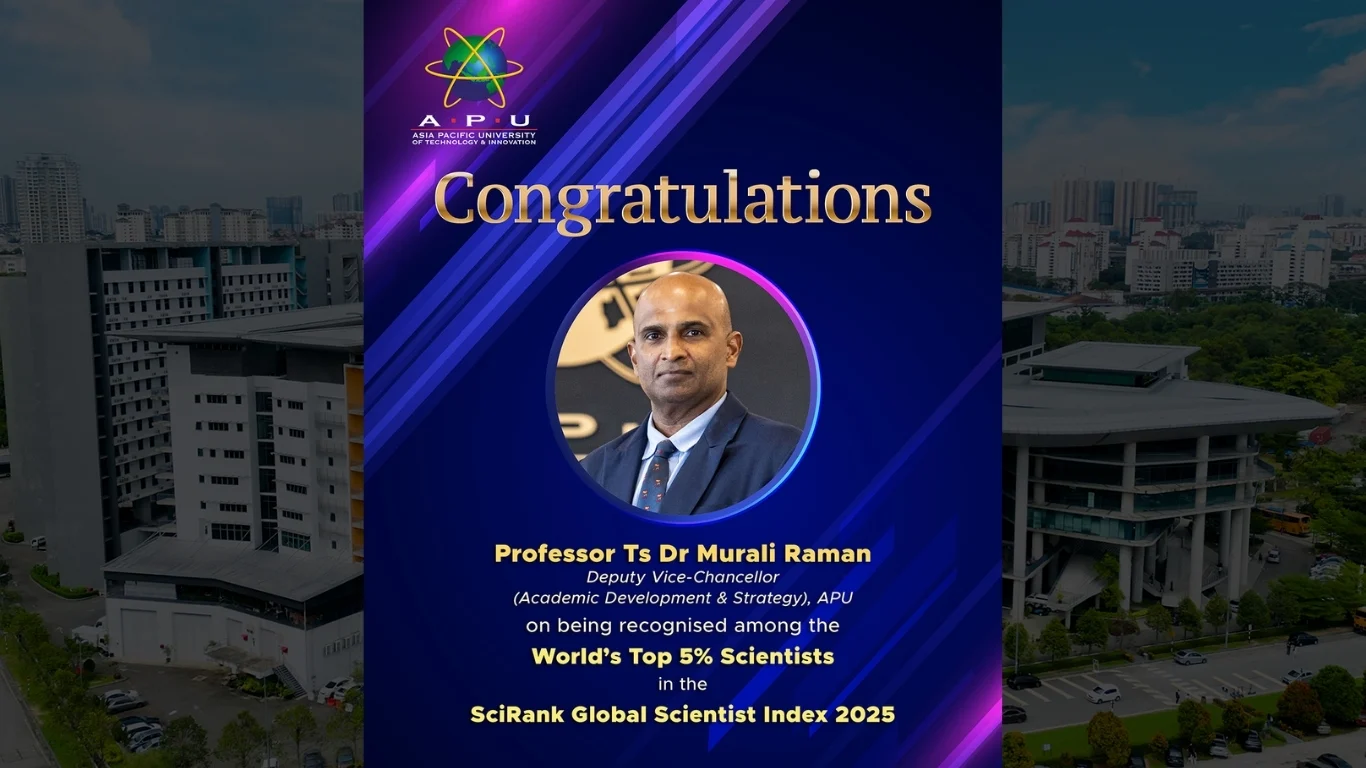
Malaysia’s academic community is celebrating another achievement as Asia Pacific University of Technology & Innovation (APU) Deputy Vice-Chancellor (Academic Development & Strategy), Prof Ts Dr Murali Raman, has been recognised among the World’s Top 5% Scientists in the SciRank Global Scientist Index 2025.
The recognition, announced by APU, places Prof Murali among the top five per cent of active researchers evaluated by SciRank Global.
The 2025 index assessed more than eight million researcher profiles and 20 million scholarly works from over 150 countries, using data from the OpenAlex research database.
Prof Murali’s recognition reflects his contributions to research in areas including digital transformation, Information Systems Management and Design Thinking. His work focuses not only on academic knowledge but also on applying research to real-world challenges, with an emphasis on people, inclusion and meaningful innovation.
Known at APU as a “Design Thinking Guru”, Prof Murali has applied Design Thinking to areas such as leadership, institutional strategy, innovation and problem-solving. His academic journey also includes recognition as a Rhodes Scholar, Fulbright Fellow and Stanford University-certified Design Thinker.
Beyond his individual achievement, the recognition also highlights the growing importance of research and innovation within Malaysia’s higher education community.
As Deputy Vice-Chancellor, Prof Murali plays a role in strengthening APU’s academic development and research culture while encouraging educators, students and researchers to explore new approaches to learning and problem-solving.
Prof Murali said the recognition was not only a personal milestone but also an affirmation of the research culture being developed at APU. He expressed hope that the achievement would encourage emerging researchers and postgraduate students to remain curious, collaborate across disciplines and pursue research that can make a meaningful difference.
The achievement serves as an inspiration to Malaysia’s young academics and students, showing how research carried out locally can gain international recognition and contribute to wider global discussions. It also reinforces the importance of creating a strong research environment where knowledge, innovation and collaboration can benefit society.
Source: APU